💻 Office work and muscle pain
Why your body doesn't like to stay still for too long
Why your body doesn't like to stay still for too long

Do you end your workday with a stiff neck, tense shoulders, or lower back pain?
You are not alone. Spending several hours in front of a computer can become uncomfortable, especially when you stay in the same position for a long time.
But contrary to what we often hear, The problem isn't necessarily your posture. It's also the lack of movement.
We are often told that we should stand up straight, keep our shoulders back and avoid slouching.
However, no single posture is suitable for everyone, and a position considered "bad" does not automatically cause pain.
Even a perfectly straight posture can become uncomfortable if maintained for several hours.
The best posture is often the one that can be changed regularly.
The goal is therefore not to stay perfectly straight all day, but to vary positions and move around more.

When you work at the computer for a long time, certain muscles remain active to support your head, arms, and torso.
This prolonged muscular activity, combined with a lack of movement, can contribute to a feeling of fatigue or stiffness.
Several other factors may also play a role:
It is important to understand that Pain is rarely caused by a single factor..
You don't need to do a workout at the office to feel better.
Simply try to regularly interrupt long periods of sitting.
Every 30 to 60 minutes, depending on your needs:
The important thing is not to follow a rigid rule, but to move regularly.
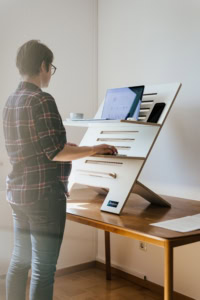
It is often thought that a good workstation consists of an ergonomic chair, a well-positioned screen and a keyboard at the right height.
These elements are important, but they only represent part of the solution.
Even the best ergonomic chair cannot replace movement.
🔄 Example of a workday in motion
At Centre Kinesis, we encourage our clients to vary their working positions throughout the day.
For example, a person with an adjustable desk could try this rotation:
In a comfortable chair.
At his desk.
On a Swiss ball, if that position suits him.
By varying your support points and moving regularly.
Then start the cycle again, adapting it to your needs.
Several of our clients who have adopted this way of working report a reduction in their neck, shoulder and even lower back pain.
What seems to make the difference for them is not a particular posture, but the fact of no longer remaining in the same position for hours.
However, this is not a one-size-fits-all solution. The durations can be adjusted, and the Swiss ball remains an option rather than a necessity. It also does not replace breaks for walking and moving around.
The real objective: to arrange one's work environment to facilitate changing positions, rather than seeking a perfect posture.
If you spend most of your day sitting, it can be beneficial to engage in activities that get you moving.
Walking, swimming, cycling, muscle strengthening exercises or simply everyday activities can contribute to your physical health.
It is not necessary to become an athlete.
The important thing is to find activities that you enjoy and that you can do regularly.
Occasional stiffness after a long day at work is common.
However, if your pain persists, recurs regularly, or limits your activities, a professional assessment can help identify the factors contributing to your discomfort.
Pain accompanied by new or progressive weakness, significant numbness, or other unusual symptoms warrants medical evaluation. Some sudden or severe symptoms require urgent care.
There is no perfect posture that should be maintained all day.
To improve your comfort at the office:
Your body is made to move, not to stay still for hours.
Do you regularly experience tension in your neck, shoulders or back?
The Kinesis Centre team can help you better understand your discomforts and find solutions tailored to your needs.
Are stretches really useful? When and how should they be done?

We often hear that stretching provides no real benefit.
We also hear that you shouldn't stretch before exercise, especially "when you're cold".
But what if stretching was actually one of the keys to:
The problem is not the stretching itself.
The problem is the way we stretch.
A stretch should always be:
Painless
Slow
Comfortable
When you create pain, you activate a protective mechanism in the body.
👉 The muscle contracts
👉 You are going against the stretch
👉 The risk of injury increases
The goal is simple:
👉 Find the maximum amplitude painless
👉 Maintain this position
After about 20 secondsThe nervous system understands that the position is safe.
At this point:
the muscle begins to relax
the real stretching begins
Breathe slowly
Stay relaxed
Never force
👉 3 x 60 seconds per muscle
Stretching takes time.
It's a slow process — a bit like yoga.
👉 A good time to do them: while watching television.
In an ideal situation:
no pain
no tension
optimal mobility
👉 Stretching before the activity is not necessary
👉 They can even temporarily decrease muscle power
Let's take a volleyball player who needs power to jump.
If his muscles are already in optimal condition and he stretches before a match:
It may lose its explosiveness
its performance may be temporarily reduced
This is not ideal in a competitive context.
The reality is quite different.
👉 99% of people:
have tensions
are in recovery
live with stress
This means that the muscles are not not at their optimal length.
In these situations, stretching is very useful for:
reduce tensions
improve mobility
to restore the muscles to a more optimal length
👉 In this context, stretching before activity can be beneficial.
Stretching is neither useless nor dangerous.
👉 It all depends on how they are made.
Too aggressive → can be harmful
When executed correctly, they become a powerful tool.
👉 Stay below the pain threshold, be patient and let the body adapt.
Are stretches really useful? When and how should they be done?
We often hear that stretching provides no real benefit.
We also hear that you shouldn't stretch before exercise, especially "when you're cold".
But what if stretching was actually one of the keys to:
The problem is not the stretching itself.
The problem is the way we stretch.
A stretch should always be:
Painless
Slow
Comfortable
When you create pain, you activate a protective mechanism in the body.
👉 The muscle contracts
👉 You are going against the stretch
👉 The risk of injury increases
The goal is simple:
👉 Find the maximum amplitude painless
👉 Maintain this position
After about 20 secondsThe nervous system understands that the position is safe.
At this point:
the muscle begins to relax
the real stretching begins
Breathe slowly
Stay relaxed
Never force
👉 3 x 60 seconds per muscle
Stretching takes time.
It's a slow process — a bit like yoga.
👉 A good time to do them: while watching television.
In an ideal situation:
no pain
no tension
optimal mobility
👉 Stretching before the activity is not necessary
👉 They can even temporarily decrease muscle power
Let's take a volleyball player who needs power to jump.
If his muscles are already in optimal condition and he stretches before a match:
It may lose its explosiveness
its performance may be temporarily reduced
This is not ideal in a competitive context.
The reality is quite different.
👉 99% of people:
have tensions
are in recovery
live with stress
This means that the muscles are not not at their optimal length.
In these situations, stretching is very useful for:
reduce tensions
improve mobility
to restore the muscles to a more optimal length
👉 In this context, stretching before activity can be beneficial.
Stretching is neither useless nor dangerous.
👉 It all depends on how they are made.
Too aggressive → can be harmful
When executed correctly, they become a powerful tool.
👉 Stay below the pain threshold, be patient and let the body adapt.


